What Is a Manufacturing Execution System (MES)?
Modern manufacturing breaks down when execution can’t keep pace with planning. Learn where a manufacturing execution system (MES) comes into play, how it works, and where it delivers the most value on the shop floor.
Modern, multi-line manufacturing operations have become more complex than most control systems can handle. When production schedules, material availability, quality checks, and equipment status aren’t coordinated in real time, downtime becomes expensive very quickly.
For example, unplanned downtime costs automotive manufacturers $2.3 million per hour, while, at the low end, fast-moving consumer goods (FMCG) facilities lose $36,000 per idle hour, according to Siemens' 2024 True Cost of Downtime report.
A manufacturing execution system (MES) provides the operational intelligence layer between business planning and production execution. It controls how products are manufactured by tracking every material batch, process parameter, and quality measurement in real time.
This article examines what MES software is and how it delivers measurable improvements in efficiency, quality, and regulatory readiness. Let’s dive in.
What Is MES?
A manufacturing execution system is software that manages and records all activities during production—from the moment work begins on a job to the moment it leaves the line.
MES acts as the operational layer between planning systems, like enterprise resource planning (ERP) and product lifecycle management (PLM), and the shop floor, giving manufacturers a real-time view of progress, issues, and quality.
An MES guides operators through processes, captures data at each step, and provides supervisors with insights into operations.
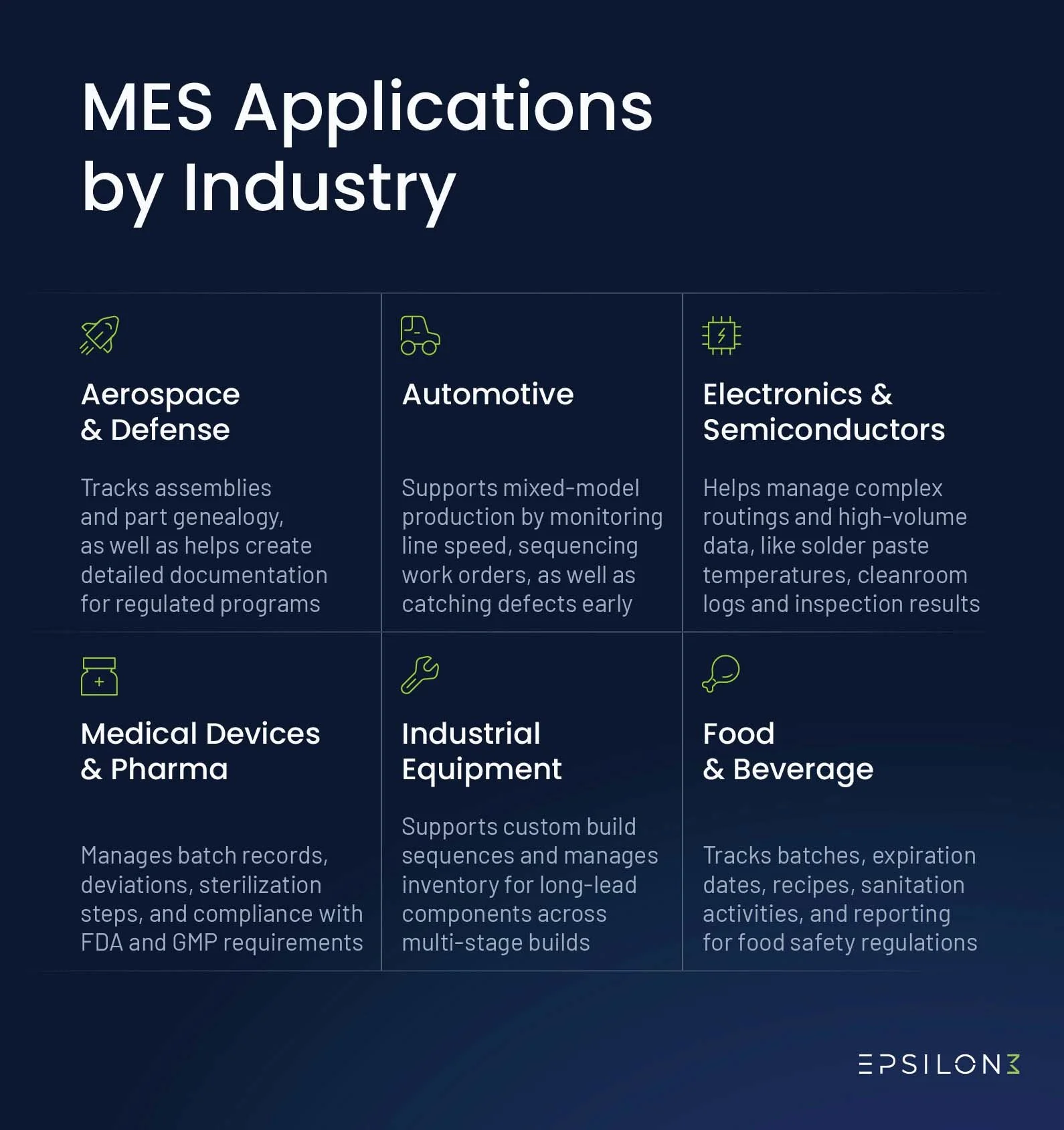
For regulated industries like pharmaceuticals, aerospace, and medical devices, this granular visibility transforms compliance from a documentation burden into an automated byproduct of production.
What is a cloud-based manufacturing execution system?
A cloud-based manufacturing execution system is an MES delivered through secure cloud infrastructure rather than on-premise servers.
The core functionality is the same, but a cloud MES stores and updates production data, procedures, work orders, and quality records in the cloud.
This removes the need for local servers and reduces the need for internal IT resources to maintain the system. Operators can access the MES from any authorized device, like a laptop, tablet, or smartphone. This makes it easier to coordinate work across multiple plants and distributed teams.
How Does MES Software Work?
An MES supports day-to-day production by connecting people, machines, and systems. It collects data as work happens, guides operators through each step, and keeps planning systems up-to-date.
Here's how it operates step-by-step:
Connects to machines and operators: MES software pulls data from programmable logic controllers (PLC), sensors, barcode scanners, and manual entries. It gathers cycle times, temperatures, pressures, and operator confirmations.
Tracks production as it happens: The system monitors work orders, material movements, machine status, and progress at every station. You can see exactly how many units are in the queue, in progress, or completed.
Controls and guides workflows: MES production software delivers digital work instructions, displays quality checklists, and sequences tasks. This helps operators easily understand work orders, timelines, and tools to use.
Identifies issues in real time: MES flags bottlenecks, downtime, deviations, and quality failures the moment they occur. Alerts are sent to supervisors' phones or via dashboard notifications.
Optimizes production decisions: Analytics help teams adjust schedules, balance workloads, and route materials to maximize capacity utilization. The system suggests corrective actions based on historical trends.
Syncs with ERP and other systems: The MES sends production counts, scrap data, and labor hours to the ERP. It receives new work orders, bill-of-materials updates, and inventory levels. This synchronization keeps business systems aligned with the shop floor.
MES Integrations
Manufacturing software systems deliver the most value when they're connected to the systems teams already use. Such integrations reduce manual data entry and automate data flow between planning, production, quality, and maintenance tools.
Enterprise resource planning: The ERP generates production orders based on customer demand and sends them to the MES. During production, MES tracks the number of items made, materials used, and work hours spent to streamline workflows and restock automatically.
SCADA and PLC systems: MES production software automatically pulls data from the PLC and supervisory control and data acquisition (SCADA) to report cycle times and sensor results without manual operator entry.
Quality management system (QMS): Inspection results from MES flow are sent automatically to the QMS for statistical analysis. If measurements approach the specification limits, the system sends alerts before parts go out of tolerance.
Computerized maintenance management system (CMMS): MES uses API integrations to link equipment usage and condition to maintenance schedules. When a machine exhibits abnormal behavior or requires scheduled maintenance, MES can flag it, notify maintenance teams, or trigger preventive tasks.
IoT/IIoT platforms: MES aggregates higher-resolution data from smart sensors to monitor environmental conditions in real time. This gives manufacturers deeper insight into process conditions and early warning signs of problems.
Benefits of Utilizing an MES System
Implementing MES software transforms manufacturing operations across quality, efficiency, and compliance dimensions. Here are different ways an MES system can help optimize your production:
Improved production visibility
An MES gives teams continuous insight into production operations. Supervisors can see active orders, completed steps, and bottlenecks. Operators know the next steps to follow without referring to paperwork. This shared visibility reduces miscommunication and keeps work moving smoothly.
Higher efficiency and throughput
By digitizing instructions, automating data capture, and standardizing workflows, MES helps operators work faster and with fewer interruptions. Tasks that once required manual checks or paper documentation are now completed in a structured digital flow. Over time, these small improvements lead to shorter cycle times and higher output.
Reduced downtime and bottlenecks
Manufacturing execution system software identifies problems as soon as they occur—like when a machine stops, a material is missing, or a quality parameter goes out of tolerance. Teams can act immediately instead of discovering the issue hours later.
This helps prevent unplanned downtime and provides greater control over day-to-day reliability.
Better quality control and fewer defects
MES tracks deviations and quality issues in real time. This allows teams to take corrective actions before defects arise. Operators can efficiently conduct root-cause analyses and identify when measurements approach critical limits through automated statistical process control (SPC) alerts, though human intervention remains essential for interpreting complex variables and executing final process adjustments.
Stronger traceability and compliance
Regulated manufacturers face constant audit pressure. Manufacturing software systems maintain complete production records, including timestamps and electronic signatures.
This reduces the time teams spend preparing for audits and provides manufacturers with the documentation required to meet regulatory requirements.
Lower operational costs
Manufacturing execution system software reduces costs through multiple mechanisms, like automated data collection, electronic batch scheduling, and material consumption tracking. This helps teams reduce rework and avoid material overuse, which reduces working costs.
Data-driven agility in scheduling and resources
Because MES provides a live view of production, managers no longer need to rely on delayed reports or manual updates to drive their operations. With real-time visibility, teams can dynamically allocate labor, equipment, and materials based on the actual workload.
Whether facing a machine outage, a material shortage, or a sudden rush order, leadership can make informed quality and scheduling decisions instantly, ensuring the overall plan remains under control.
Reduced waste and rework
MES uses structured procedures and automated checks to prevent errors from reaching downstream operations. Operators are alerted the moment a parameter falls outside its acceptable range, giving them time to correct before the production derails.
Seamless coordination with ERP and other systems
With clean integrations between MES, ERP, QMS, CMMS, and machine-level systems, production no longer operates in isolation. Data remains consistent across all departments, reducing confusion and improving operational alignment.
How To Choose the Right MES Solution
Choosing a manufacturing software solution requires more than comparing feature lists.
Every factory operates differently, so the best system is the one that fits your processes, compliance requirements, and growth plans. Here’s how you can assess and choose the right manufacturing software company.
Assess your needs
Before reviewing vendors, take stock of the operational challenges you need to solve. Some teams need better visibility into work in progress, while others need stronger traceability, controlled procedures, or a structured approach to quality management.
Here are a few things to define:
Identify specific objectives: Are you improving production efficiency to meet growing demand? Do you need better traceability to satisfy regulatory requirements? Are quality issues driving excessive scrap rates? Identify the specific objectives you want to achieve with the MES.
Document non-negotiable functionalities: Map out the non-negotiables that you need the most, like real-time monitoring, digital work instructions, batch traceability, equipment connectivity, or auditability.
Budget considerations extend beyond licensing fees: Factor in implementation costs, ongoing maintenance, training, and potential customization expenses. Cloud-based systems typically spread costs through predictable subscriptions, while on-premises deployments require a larger upfront investment.
Evaluate system features and performance
Once your requirements are clear, the next step is to evaluate how each MES performs under real operating conditions. A good way to benchmark systems is to review a vendor’s documented capabilities and feature comparisons against your manufacturing workflows.
Here are the key features to consider when evaluating:
Real-time production monitoring: Facilitates immediate visibility for supervisors when machines stop, work queues build up, or output rates drop below targets
Production scheduling: Adapts dynamically to disruptions and automatically resequences jobs based on current equipment availability, material on hand, and updated priorities
Inventory management: Maintains real-time visibility about material locations, batch allocations for specific work orders, and component expiration dates
Quality management: Analyzes measurement trends and alerts operators when processes drift toward specification limits
Traceability and genealogy: Reconstructs the exact material batches, operators, recorded process parameters, and quality checks when an issue is raised
Work order management: Delivers digital instructions directly to operator workstations, updates status as each step completes, and provides managers with accurate progress visibility
Performance analysis: Automatically calculates overall equipment effectiveness (OEE) by tracking machine run cycles, output quality standards, recurring slowdowns, and quality degradation on specific equipment
Maintenance management: Tracks machine runtime and cycle counts, and notifies maintenance systems when preventive service comes due
Data collection and reporting: Captures temperatures, pressures, cycle times, and inspection results directly from equipment and sensors
Integration with ERP and other systems: Maintains bidirectional data flow with ERP systems to keep material consumption, labor hours, and production completions synchronized automatically
Get to know the MES vendor
Customer testimonials reveal how the MES company performs beyond marketing claims. Look for references from manufacturers with similar production volumes and regulatory requirements.
Based on these, shortlist two to four MES vendors and schedule a demo.
Bring your production data, work instructions, and integration requirements to help evaluate how intuitively the MES can integrate with your production.
Current MES Standards and How They’ve Evolved
MES follows a defined set of industry standards to ensure consistency, interoperability, and reliable data exchange across equipment, software, and production environments.
The most widely recognized framework is ISA-95, which outlines how MES should interact with ERP, control systems, and shop floor equipment. It defines interfaces between business systems (like ERP) and manufacturing operations.
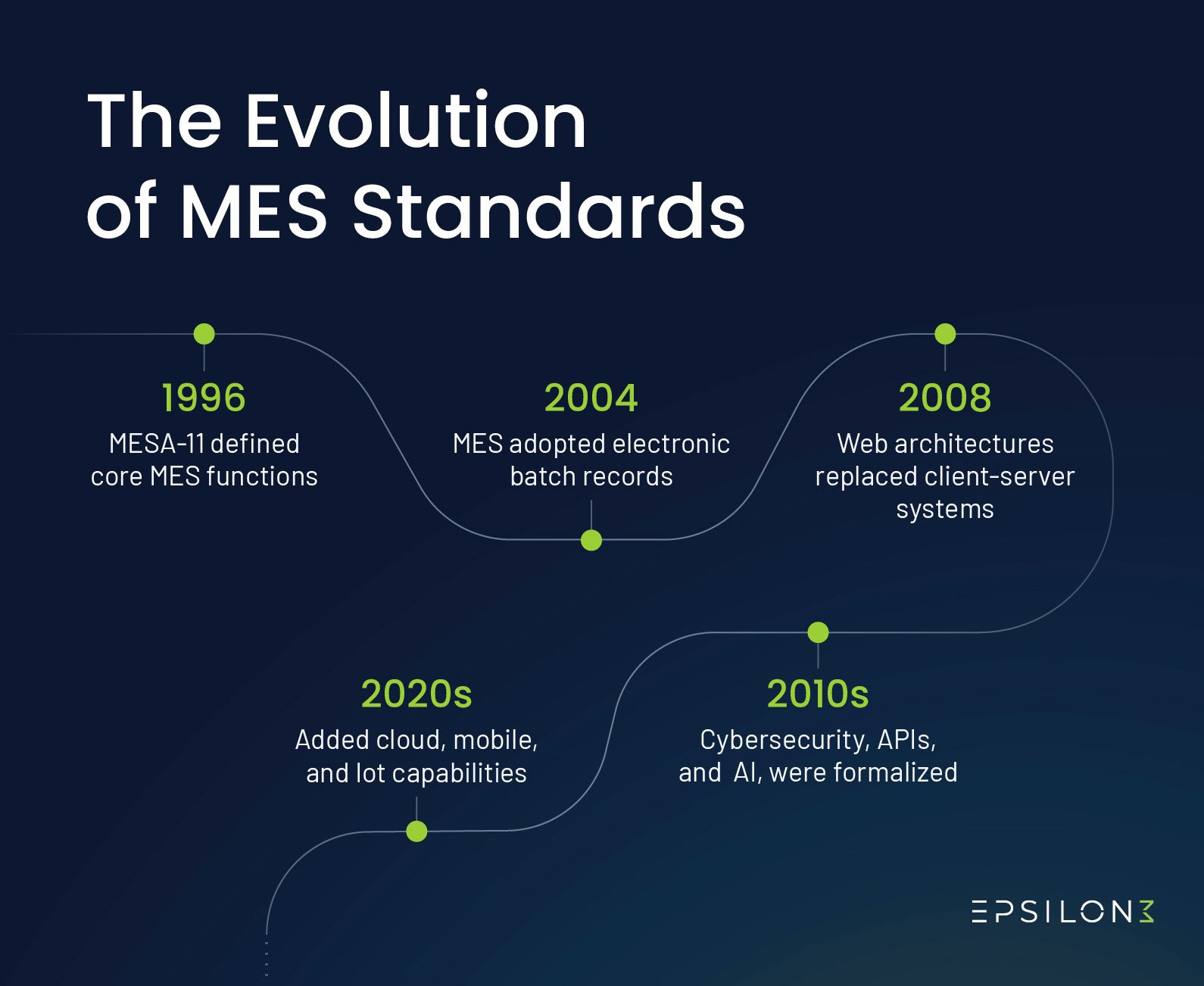
Manufacturing Enterprise Solutions Association International (MESA International) developed functional models describing 11 core MES capabilities. Here’s how the MESA standards have evolved in the last few decades:
1996: The original MESA-11 was developed to establish foundational models. It focused on data collection and reporting.
2004: MES expanded to support electronic batch records, digital quality checks, and more structured workflows.
2008: Service-oriented architecture principles and web-based interfaces replaced client-server deployments.
2010s: Mobile access, cloud deployment, and IoT integration expanded the frameworks, with Industry 4.0 driving the update for advanced analytics.
2020s: Standards emphasize API-first architectures, low-code configuration, and AI-powered decision support. Cybersecurity requirements become explicit.
Modern MES systems are expected to support faster implementation, deeper integrations, and stronger traceability than earlier generations, without sacrificing reliability or compliance.
An MES Solution Purpose-Built for Speed, Efficiency, and Traceability
Epsilon3 delivers a modern MES designed for complex, low-volume production in aerospace, defense, energy, and advanced manufacturing. The platform digitizes work instructions, automates data collection, and provides complete traceability from raw materials through finished products.
Our solution's real-time tracking, automated checks, revision control, inventory management, and part genealogy features make it especially valuable for teams handling complex builds or strict compliance requirements. Epsilon3 also has a flexible integration architecture that connects to existing ERP, PLM, and quality systems.
FAQ
What is the difference between MES and ERP?
An ERP system manages business-level functions such as financial planning, procurement, and sales order processing. An MES operates at the execution level, managing product manufacturing on the shop floor. It tracks real-time production status, enforces work instructions, collects quality data, and monitors equipment performance.
When the two systems work together, manufacturers get a full view from order creation to finished product.
Is SAP an MES system?
SAP is primarily an ERP provider, but it offers MES solutions through SAP Digital Manufacturing. Many manufacturers choose to pair SAP ERP with a dedicated MES when they need deeper shop floor execution, traceability, or industry-specific workflows.
Is OEE part of MES?
Yes. Overall equipment effectiveness is often included in MES systems through built-in performance monitoring. MES automatically tracks availability, performance, and quality data, making OEE more accurate and easier to update than manual collection.
What standards should MES software follow?
Most MES systems conform to the ISA-95 standard, which defines how production systems integrate with business and automation systems. Depending on the industry, additional standards may also apply.
For instance, FDA 21 CFR Part 11 is required for pharmaceuticals, AS9100 for aerospace, and ISO 13485 for medical devices. Data security standards like ISO 27001 and SOC 2 protect intellectual property. And cloud-based systems should maintain compliance certifications relevant to your industry's regulatory environment.

If you are a current user of Epsilon3, contact support@epsilon3.io for the review link to earn $50 before submitting.