






For aircraft, spacecraft and the parts that go into them
Certification, on the record.
Epsilon3 runs the conformity checks, ground tests and flight tests behind your certification plan, and ties every result to the requirement it shows, whoever the authority is.
Start from the compliance checklist.
Import the requirements and means of compliance from your certification plan, and pin each one to the procedure that will show it.
Conform it. Then test it.
Conformity of the article and the test setup comes first. Then every reading is captured against the serial, the step and the person who signed it.
Fly the test campaign.
Test points, live flight data and crew sign‑offs in one view, each test card tied to the requirement it covers.
Findings keep their provenance.
Results are checked against the pass/fail criteria as they are recorded. Anything open stays linked to the article, the run and the step that produced it.
Review on the record.
Share the compliance report with your delegated engineers, your design organisation or the authority itself: the FAA, EASA, Transport Canada, the UK CAA. Questions and answers stay attached to the evidence they are about.
Every line closed.
Each item on the compliance checklist points to the test, the article and the signature behind it. The authority makes the finding from one traceable record.
From prototype to fleet.
The record follows the vehicle into production and service, so the next change, the next approval and the next part start from what you already showed.
- 25.143ControllabilityFlight test
- 25.161TrimFlight test
- 25.203Stall characteristicsFlight test
- 25.901Powerplant installationGround test
- 25.1181Fire zonesNot mapped
- Takeoff
- Climb perf.
- Stall series
- Handling
- Ceiling
- Stall warning margin 6.2 kt · 25.207 ≥ 5 ktPass
- Roll at stall 12° · criterion ≤ 20°Pass
- Config 2 · aft CG · warning margin not yet shownOpen
- 25.143 Controllability · evidence attached
- 25.161 Trim · evidence attached
- 25.203 Stall characteristics · 1 open question
- Authority · M. Chen
Please add stall warning margin for the aft‑CG configuration (config 2).
- Flight test · J. Okafor
Added — Card 6 run 2, section 4.2 of the report. Margin 6.2 kt.
- Authority · M. Chen
Reviewed. No further questions on 25.203.
One record, whatever you’re certifying.
An airframe, an engine, a launch vehicle, a spacecraft or a reactor: the evidence has the same shape. A requirement, the test that shows it, the article it ran on and the person who signed.
Every line of the checklist, traced.
Type certificates, supplemental type certificates and major changes, run against the certification basis you agreed with the authority. Fixed‑wing, rotorcraft, eVTOL and uncrewed.
- 25.143ControllabilityEvidence attached
- 25.203Stall characteristics1 open item
- Checklist lines
- 412
- Test points
- 1,860
- Flight testFT‑04, cards 6 to 9
- AnalysisHandling qualities report
- SimulatorPilot evaluation, three sessions
- Article matches type design data
- Test setup and instrumentation conformed
- Inspector sign‑off
Qualified at the bench. Traceable in the field.
Engine type certification and parts and appliance approvals, with qualification runs and part and serial genealogy that travel with the article into your customer’s program.
- EnduranceBlock test, test cell 3Pass
- ContainmentBlade‑off rig testScheduled
- Test hours
- 1,240h
- Starts
- 3,180
- TestOverspeed run, test cell 3
- AnalysisRotor life and stress
- InspectionTeardown after test
- Disassemble per test plan
- Record findings and images
- Engineering sign‑off
Mission after mission, on the record.
Ground and flight safety, test campaigns and launch‑day checklists in one record, building the evidence your licence depends on, from the FAA’s Part 450 to the UK’s spaceflight regulations.
- Flight safetyAnalysisEvidence attached
- Mishap planResponse drillDrill due
- Hot‑fires
- 46
- Burn time
- 3,912s
- TestFull‑duration hot‑fire SF‑07
- AnalysisDebris and dispersion
- ProcedureRange safety poll, every station
- Hazard areas cleared
- Go / no‑go poll, every station
- Launch director sign‑off
Airworthy before it flies.
Military airworthiness runs on the same evidence: criteria agreed with the airworthiness authority, test and analysis against each one, and a signed record behind every flight clearance.
- StructuresStatic test completeShown
- Flight controlsEnvelope expansionIn test
- Test hours
- 212.6FH
- Test points
- 1,420
- TestFlutter, Mach 0.6 to 0.9
- AnalysisLoads model update
- ReviewSafety review board
- Test points flown and reviewed
- Deficiencies dispositioned
- Airworthiness sign‑off
Qualified before it launches.
Spacecraft qualification and mission assurance: environmental campaigns against every requirement, with the article, the setup and the signer on one record before it ships.
- VibrationRandom, three axesPass
- Thermal vacCycle 6 of 8Running
- Test hours
- 1,180h
- Requirements
- 640
- TestEnvironmental campaign EC‑3
- AnalysisThermal model correlation
- InspectionWorkmanship, after test
- Verification matrix closed
- Open items dispositioned
- Mission assurance sign‑off
Every acceptance criterion, closed.
New reactors are licensed on the same shape of evidence: inspections, tests and analyses against acceptance criteria agreed with the regulator, with equipment qualification and quality records on one signed record.
- Injection flowSafety system testMet
- Leak rateContainment testScheduled
- Qualification hours
- 2,400h
- Test runs
- 38
- TestSeismic and environmental
- AnalysisAging and service conditions
- InspectionAs‑installed walkdown
- Line up system per procedure
- Record flow and pressure
- Independent verification
The evidence is everywhere. No two packages look the same.
The checklist lives in a spreadsheet, test data in another system, conformity on paper and the authority’s questions in email. And there’s no common format, at home or abroad: every applicant builds its own package, and every reviewer starts by learning it.
- The checklistA spreadsheet that drifts from the plan as soon as testing starts.One list, each line pinned to the procedure that shows it.
- Test dataExported, renamed and attached to a report weeks after the run.Captured against the step, the serial and the signer as it’s recorded.
- ConformityPaper forms that have to be matched back to the article and the setup.Inspected and signed in the same run as the test it clears.
- ReviewQuestions in email, answers in a revised PDF, context lost between them.Questions and answers attached to the evidence they’re about.
Epsilon3 takes your evidence in whatever format it’s in and structures it the same way every time. We’re working with industry and regulators toward a common digital format, so a package built once can be reviewed anywhere.
Plan.
Define the work, align schedules and dependencies, and keep teams coordinated as the program evolves.
For certification: the basis, the means of compliance and the plan you agreed with the authority become requirements, each waiting for its evidence.
Build.
Parts, BOMs, inventory and work orders, with the as‑built record written as the work runs.
For certification: test articles are built and conformed against the design data, so every test runs on an article you can prove.
Test.
Test plans and requirements verified against live telemetry, with pass/fail limits and a complete as‑run record.
For certification: ground, flight and qualification results close the lines they show as they’re recorded.
Operate.
Flight, launch, mission and plant operations run live with go/no‑go gates and shift logs.
For certification: what happens in service stays linked to the requirements and approvals behind it.
Sustain.
Repairs, changes and continued operation run on the same record the approval was built on.
Back to Plan: a change reopens only the lines it touches, and the next approval starts from evidence you already have.
One record for the whole life of the program.
Start from the documents you already have.
Point Epsilon3 at a folder: the authority’s forms and guidance, your certification plan and your own templates. It reads each one, tells you what it found and drafts the program around it.
- AI
Read. Propose. Draft.
- Reads every document and explains what each one is for.
- Proposes what to build: procedures, a test campaign, a test plan and requirements. Switch off anything you don’t need.
- Drafts it in Epsilon3, with a tentative schedule and the risks it found in the documents.
Shown with a supplemental type certificate folder.
From requirement to result, in Epsilon3.
Test campaigns connect what your program must verify with the plans, procedures and test events that verify it, whether that’s flight test, a hot‑fire campaign, environmental qualification or pre‑operational testing. Results roll up as they’re recorded, so every requirement shows its status and every test point traces back to what it proves.
- 1
Build the requirements library
Import from your requirements tool (Jama sync is supported) or create them here, nested from a program characteristic down to a requirement a test can close.
Requirements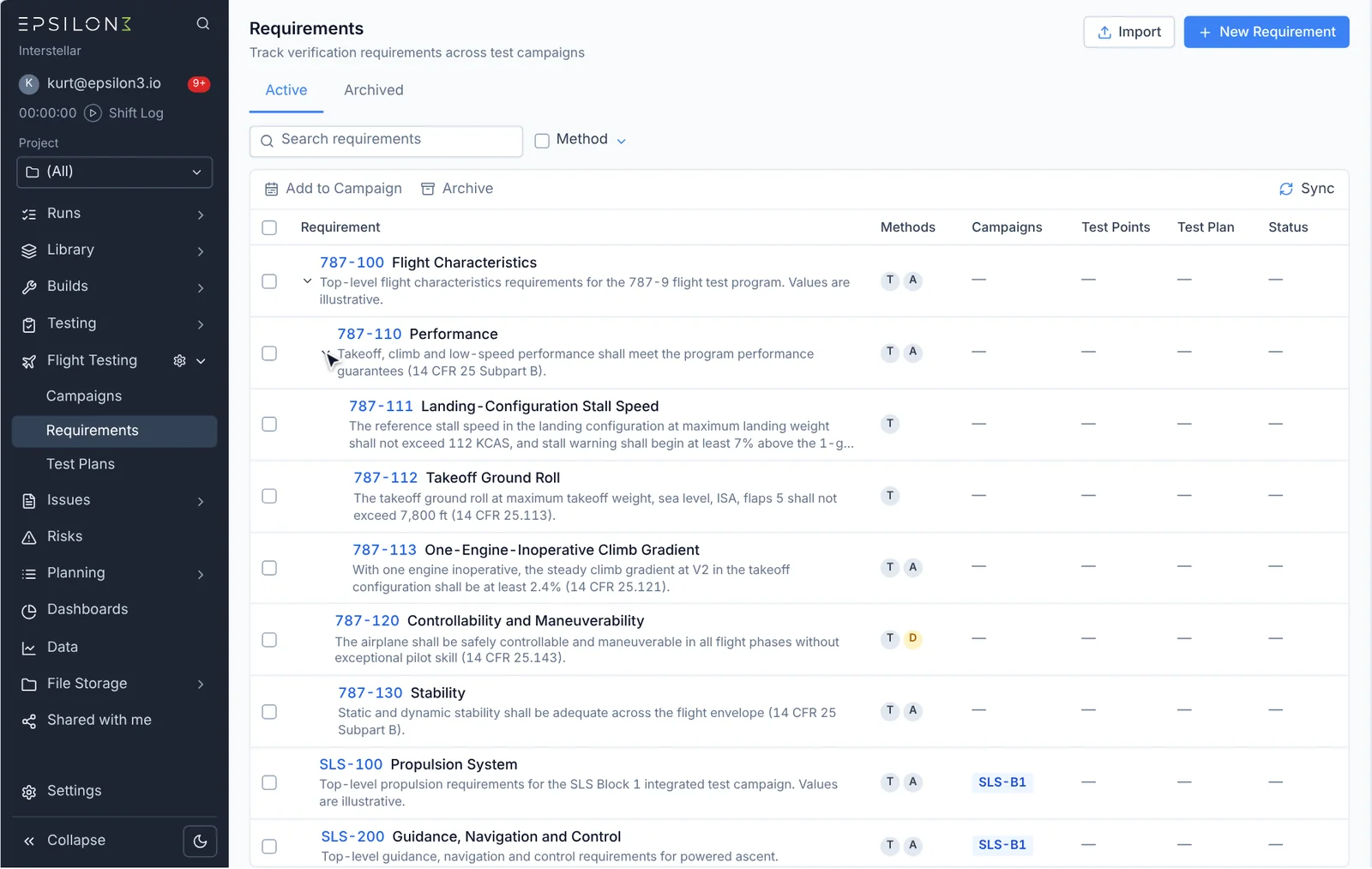
- 2
Plan the campaign
One test effort: the article, the dates and the requirements it has to close, with versioned test plans and test cards built from blocks.
Campaigns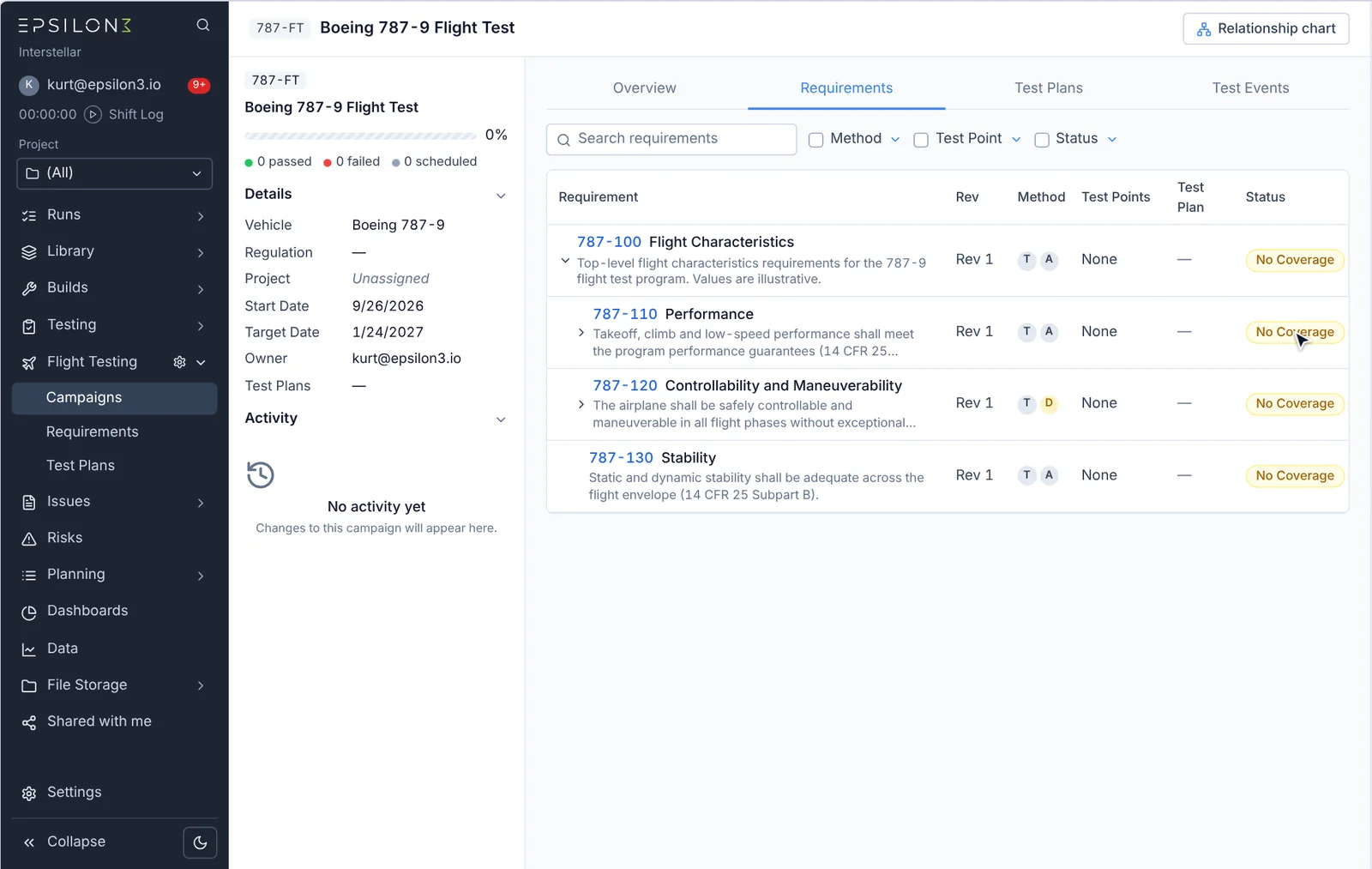
- 3
Run the test event
From test readiness review to complete, with results saved the moment they’re recorded and the original card kept as written.
Test events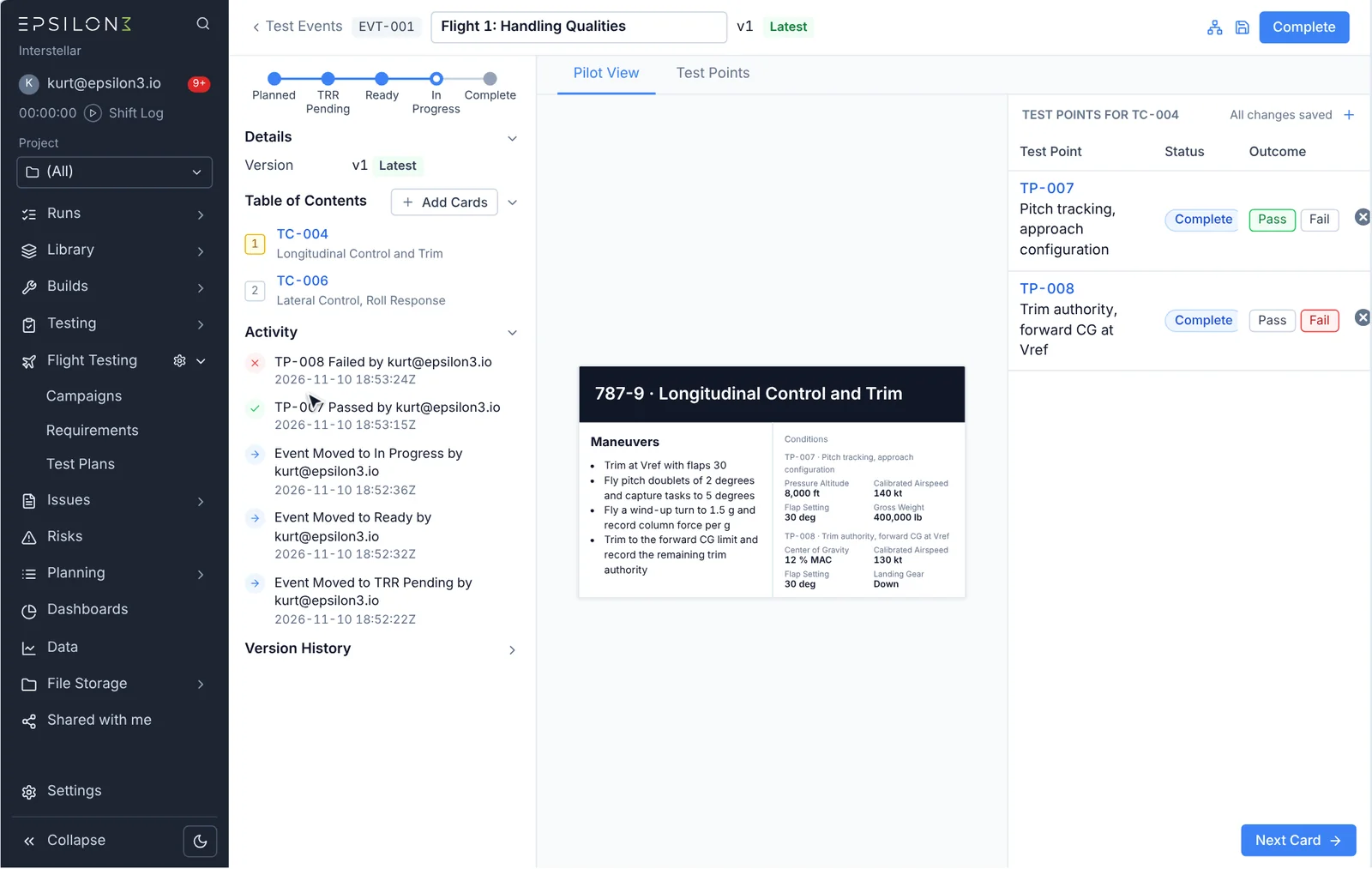
- 4
See verification as it happens
Results roll up from test points to requirements to the campaign. Follow anything that failed through the relationship chart to everything it touches.
Track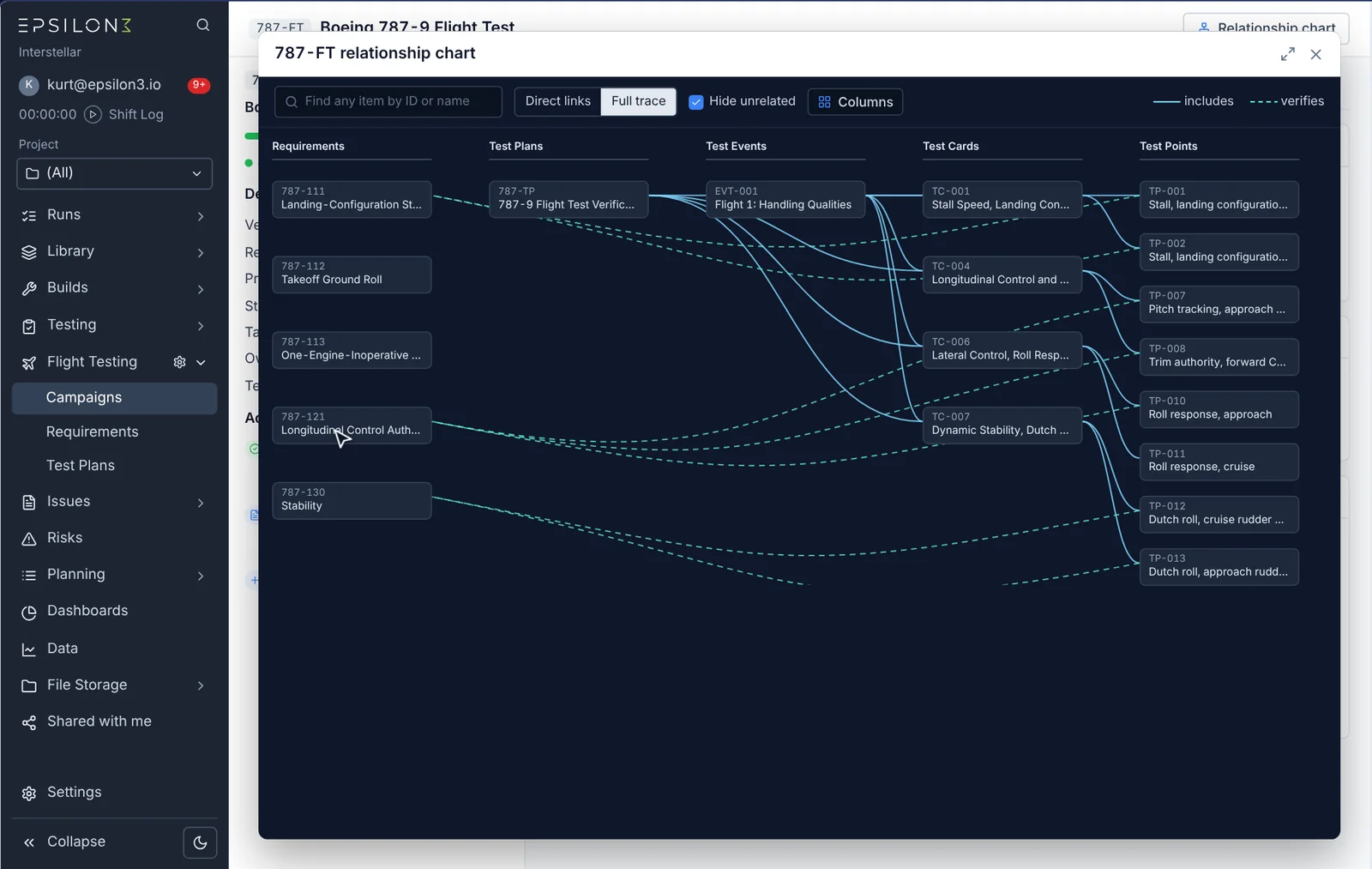
Shown in Flight Testing, now in early access, with an illustrative aircraft program. The same campaign structure runs ground, hot‑fire, environmental and qualification testing.
Conformity, sign‑offs, issues and nonconformances run on the same platform, and you can give your delegates or the authority scoped access through Epsilon3 Connect, or export the record to PDF.
Built for programs that answer to a regulator.
- FedRAMP HighAuthorized
- ITARCompliant
- NIST 800‑171Compliant
- SOC 2Type II
- CloudAWS GovCloud or international
- On‑premAir‑gapped option
Your record stays yours: you control who sees it, and you can export it at any time. Security & compliance
FAQ
Does Epsilon3 make the compliance finding?
No. The authority makes the finding, or an engineer or organisation it has approved or delegated to act for it. Epsilon3 runs the work behind the finding and keeps the record: the requirement, the procedure, the article, the data and the signature.
Which authorities does it work with?
The record isn’t tied to one regulator’s forms. The same requirements, procedures and evidence support programs certified with the FAA, EASA, Transport Canada, the UK CAA and other authorities, launch and reentry licensing, military airworthiness and nuclear licensing. Your compliance checklist and certification plan stay in your own format.
Is there a standard format for certification evidence?
Not yet, here or abroad. Every applicant builds its own package. Epsilon3 takes yours in whatever format it’s in and structures it the same way every time, and we’re working with industry and regulators toward a common digital standard.
Can we bring our existing compliance checklist and test plans?
Yes. Import requirements from your requirements tool (Jama sync is supported) or from Excel, Word, CSV or PDF, or point Epsilon3 at a folder of documents and let it draft the requirements, procedures and test plan for your team to review.
Does it work beyond new aircraft?
Yes. The same record works for engines, parts and appliance approvals, STCs and major changes, launch and reentry licensing, military airworthiness, spacecraft qualification, and nuclear licensing and equipment qualification. The evidence travels with the article into the next program.
Do we keep ownership of our data?
Yes. The record stays in your environment. You decide what your delegates, the authority or anyone else can see, and it connects to the systems you already use through the Epsilon3 API.
Bring a test procedure you actually run.
We’ll show you it running in Epsilon3, tied to the requirement it shows. We’ll cover where your program is today, the authority and rules you work to, and how your evidence is kept now.