
State of Operational Readiness: The Workaround Economy
For two decades, manufacturing, aerospace, and defense floors have run on tribal knowledge, analog processes, and disconnected realities between the shop floor and executive leadership. Between manual task handoffs, undocumented or ground-floor augmented processes, and training that deviates from the official guidance for what floor operators know works, the gap is wide. The professionals who built those workarounds are confident in their teams — because in many ways, they are the workaround.
But the next generation of operators is done tolerating it. Gen Z workers are the most confident cohort in the data and the clearest about what's broken — naming training gaps at 4.6x the rate of Boomers, process gaps at 3.6x, and leadership resistance to change at 2.5x.
To better understand how prepared these industries are for what’s coming, we surveyed over 500 experienced managers working in manufacturing, aerospace, and defense. What we found was a workaround problem: capable teams carrying accumulated structural debt that the next generation isn't willing to inherit.
Key Takeaways
Nearly half of all operations professionals (46%) say task assignments and instructions aren't digitized or automated.
C-suite executives are much more likely than independent contributors to feel "very confident" about their team's readiness (71% vs. 39%).
43% of C-suite respondents cite leadership resistance to change as a top readiness threat — the highest among roles, nearly three times the rate for independent contributors (14%).
Defense has the heaviest structural load of the three industries, with only 21% of defense workers reporting no problems with their process management tools, compared to 36% in manufacturing.
Nearly Half of All Professionals Are Still Working in Manual Mode
Digital transformation is supposed to be reshaping the way industries operate. But many professionals on the ground (and in the skies), still haven't digitized their daily workflows.
Nearly one-half (46%) of manufacturing, aerospace, and defense professionals say their task assignments and instructions aren't digitized or automated. 42% say even notifying a teammate that a task is complete still happens manually. In industries that run on precision and compliance, critical work is moving through channels with no audit trail, no built-in accountability, and no guarantee of software reliability.
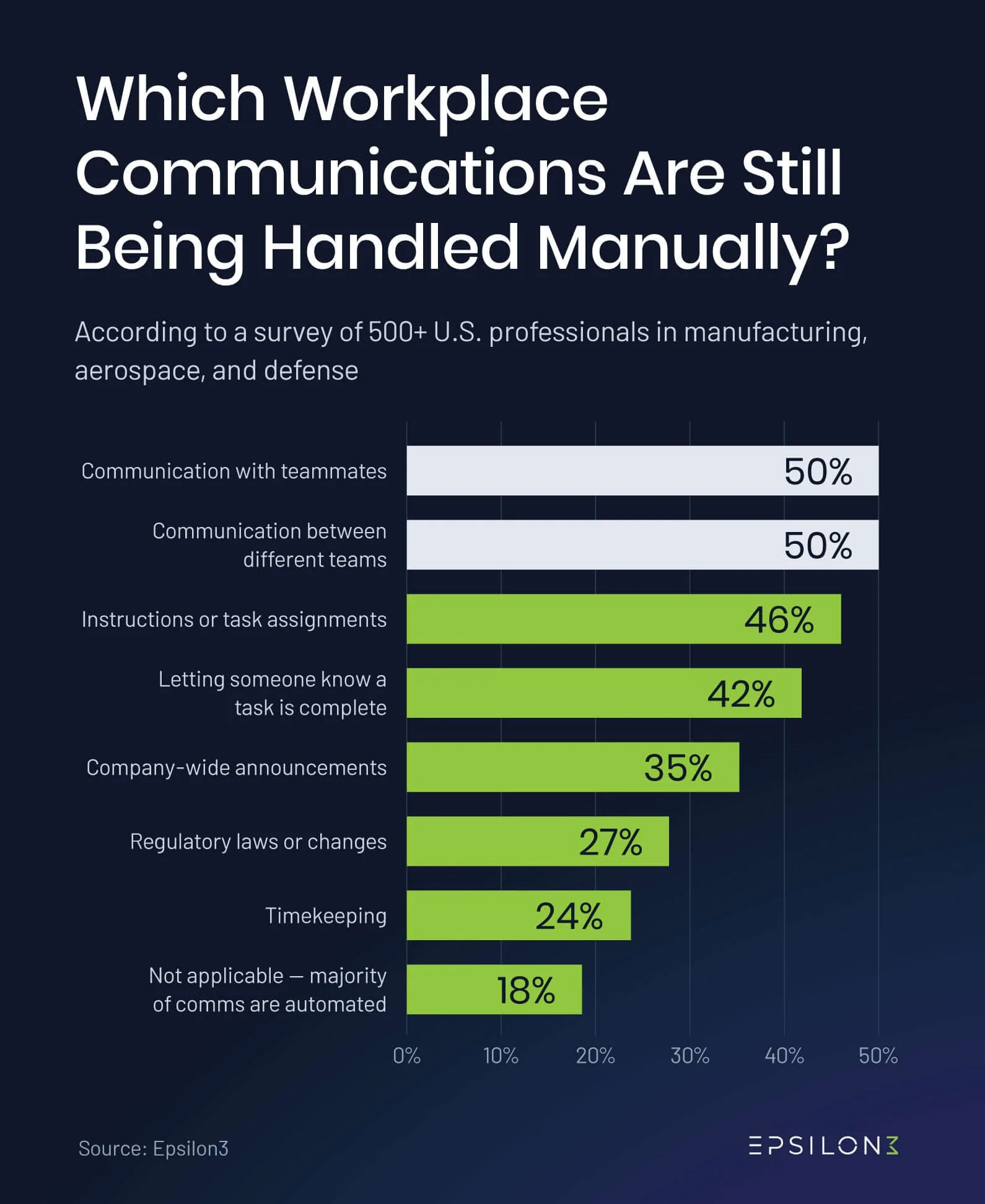
The pattern is more pronounced at mid-sized organizations. Among organizations with 101 to 300 employees, 66% of professionals report that communication between teams is handled manually, significantly higher than at the largest organizations (5,000+ employees), where 49% say the same.
These mid-sized companies may have outgrown the informal communication habits common in small teams, but they still don't have the infrastructure to replace shared inboxes and spreadsheet-based tracking with digital work instructions and structured systems.
Generational patterns tell a similar story: 58% of Gen Z workers say their task instructions arrive manually, compared to 33% of Baby Boomers. But that difference may say as much about perception as it does about process.
Boomers built their careers around existing workflows; Gen Z is the first cohort to enter these industries with a different baseline for what "normal" looks like. As that older cohort ages out, they'll take with them not just decades of experience, but the institutional tolerance that kept aging systems running.
Most Teams Acknowledge Communication Problems, but Few Have Fixed Them
More than three in five of our respondents acknowledge they have internal communication problems at their organization. That's not a fringe complaint. It's a majority view among these professionals, 61% of whom have more than 16 years of experience. These are people who know what functional communication looks like, and they're saying they don't have it.
Only 36% say they have no major problems communicating with other teams. The remaining 64% say:
41% communicate regularly, but see clear room for improvement.
13% feel siloed. They're still able to do their jobs, but they feel cut off from the broader organization.
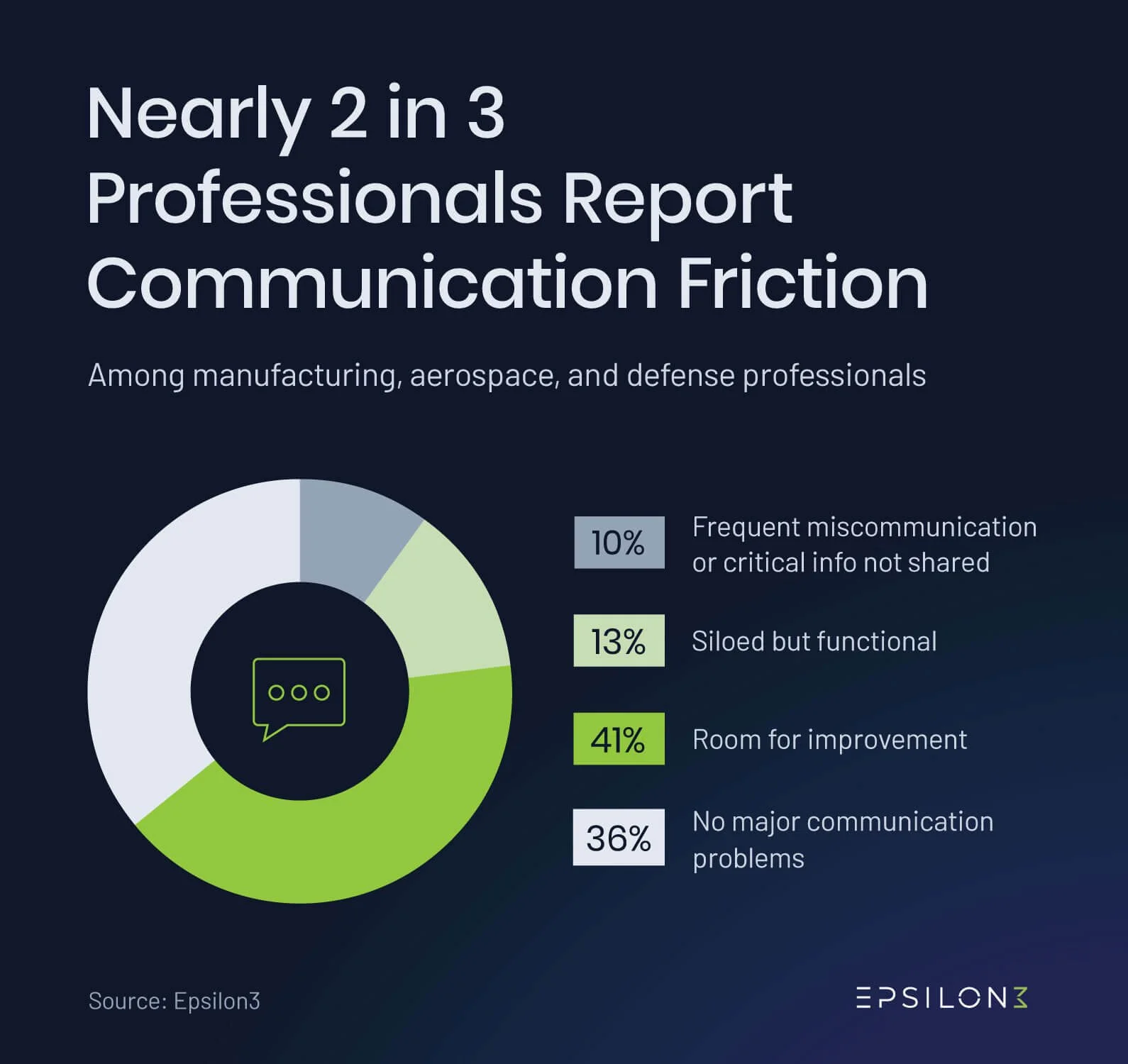
The 42% in the middle, who aren't cut off completely but also aren't communicating well, are worth examining closely. These teams may have learned to function, but in regulated programs and industries where a missed handoff or an unshared update can halt an entire operation, communication that's merely "good enough" is a liability.
The aerospace industry stands out with 17% of aerospace professionals strongly disagreeing that they can communicate effectively with other employees, roughly twice the rate in defense (8%) and manufacturing (9%). That has consequences in an industry where a missed handoff between engineering and operations can halt an entire mission.
The Biggest Readiness Threat May Already Be Inside the Building
When asked what affects their organization's readiness the most, 39% of professionals pointed to factors outside their company's control, like geopolitics and shifts in consumer behavior. These industries operate in an environment shaped by defense budgets, trade policy, and global supply chains that no single company can control, so these outside factors have a major impact on their day-to-day operations.
But the second-most-cited threat was entirely internal. More than one-quarter (29%) of technical professionals identified insufficient training, expertise, or a lack of informed personnel as a top readiness concern. Unlike geopolitics, that's a problem organizations actually have the power to fix.
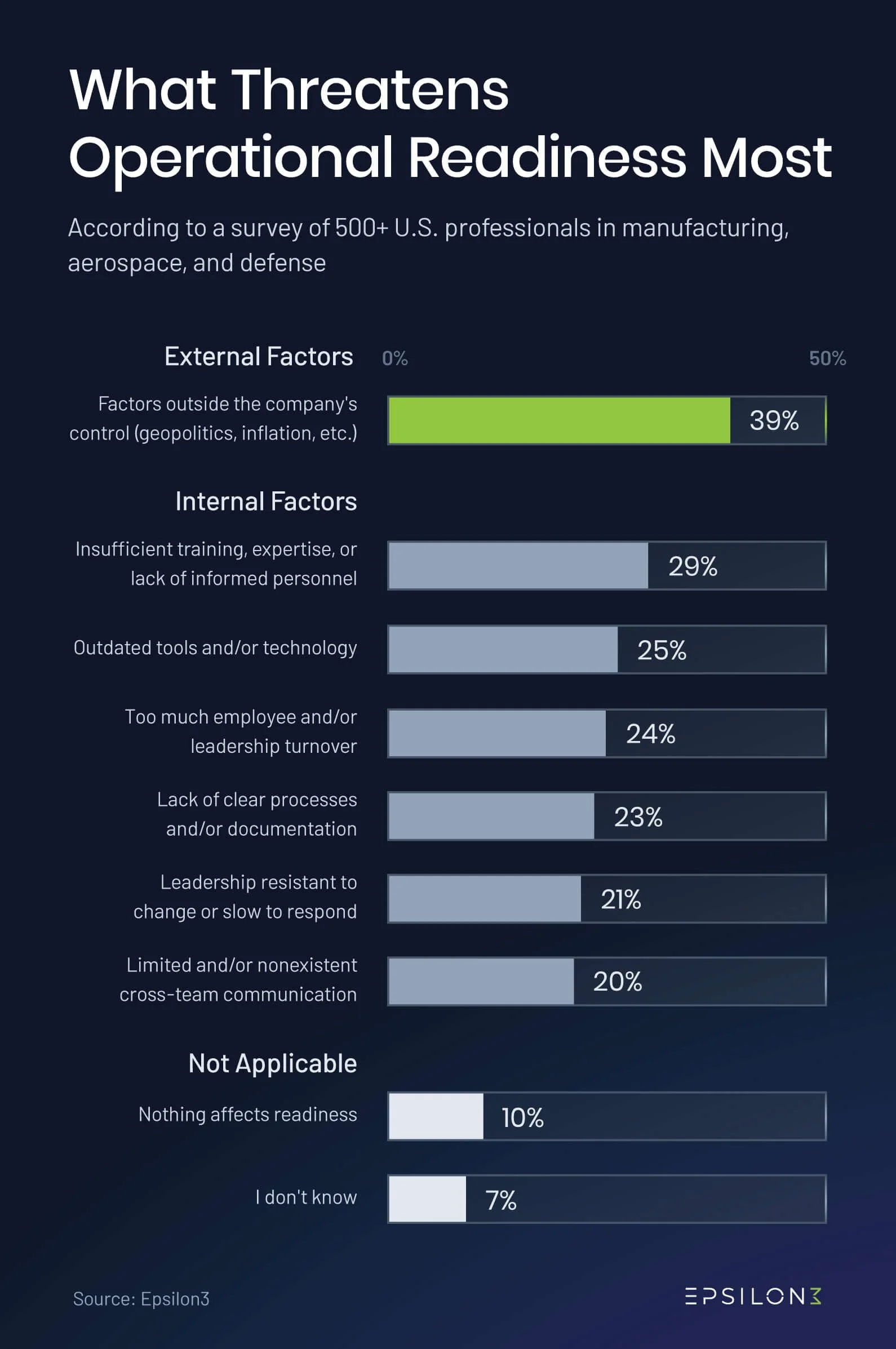
Manufacturing, aerospace, and defense aren't peripheral industries—they underpin national security, infrastructure, and global supply chains. When the professionals inside these organizations say they're undertrained and working with insufficient tools, the consequences extend well beyond any single company.
Overworked, undersupplied teams in high-stakes environments are more likely to make mistakes. In these fields, a breakdown in personnel or tools doesn't just affect productivity. It can compromise a mission readiness review or worse.
Defense carries the heaviest structural load of any industry in the sample. Nearly a third (31%) of defense professionals say their process management tools support basic organization but lack critical features, while 29% cite leadership resistance to change and 34% say regulatory updates are still handled manually — the highest rate across all three industries. Only 21% of defense workers report no problems with their tools at all, compared to 36% in manufacturing.
Individual Readiness Can't Outrun Broken Systems
The majority of independent contributors—the people closest to actual day-to-day work—feel confident about their skills, but many don't seem to have the tools to support their team in the event of an emergency. Two-thirds (66%) of independent contributors say they could respond to a major disruption immediately or within 24 hours.
71% of founders and C-suite executives say they're "very confident" their team can adapt to sudden change, compared to 39% of independent contributors. That 32-point gap likely reflects how far removed senior leadership is from the day-to-day realities their teams navigate.
And 43% of C-suite respondents name leadership resistance to change as a top readiness threat — the highest of any role, and nearly three times the rate of independent contributors (14%). They're also twice as likely to cite missing process documentation (38% vs. 20%). Senior leaders aren't just aware of what's broken. Many are naming themselves as part of it.
The confidence at the top isn't unfounded — 90% of respondents are at least somewhat confident their team can adapt, and 63% have broadly positive feelings about their process management tools. These industries aren’t broken. Capable teams are carrying systems that work until they don't, and the people closest to those systems are the ones who know it.
The Infrastructure Your Experienced Team Has Been Missing
For teams in manufacturing, aerospace, and defense, operational readiness isn't just about your employees. It's about whether the systems they use are built to match their capabilities.
Epsilon3 is built specifically to close that distance by replacing manual, error-prone manufacturing processes with structured workflows that give experienced teams the infrastructure their expertise deserves.
When your work deals with highly complex regulations, compliance, and risk assessments, Epsilon3 is your all-in-one tool to avoid costly delays and keep your team on track.
Methodology
This survey was conducted among 500 U.S. adults ages 18 and older who are currently employed within the manufacturing or aerospace/defense industries and have at least three years of total professional experience. The final sample consisted of 250 respondents employed within manufacturing and another 250 respondents employed within aerospace/defense.
Data collection began on March 17, 2026 and completed on April 8, 2026. Results were analyzed both at the total sample level and by industry subgroups where relevant. Data is unweighted, and the margin of error is approximately ±4% for the overall sample at a 95% confidence level.
